

Specialty Nameplate laser cuts thin-gauge metal parts to your drawing — flats, brackets, panels, scales, and formed components — in stainless steel, aluminum, brass, and mild/cold-rolled steel. Thickness roughly .015" to .375". Laser cutting for tight, repeatable accuracy; CNC and bending when the print calls for it. Custom to the engineering spec. Prototype through production. No minimum order. Hubbard, Ohio. CAGE 8GNP1.
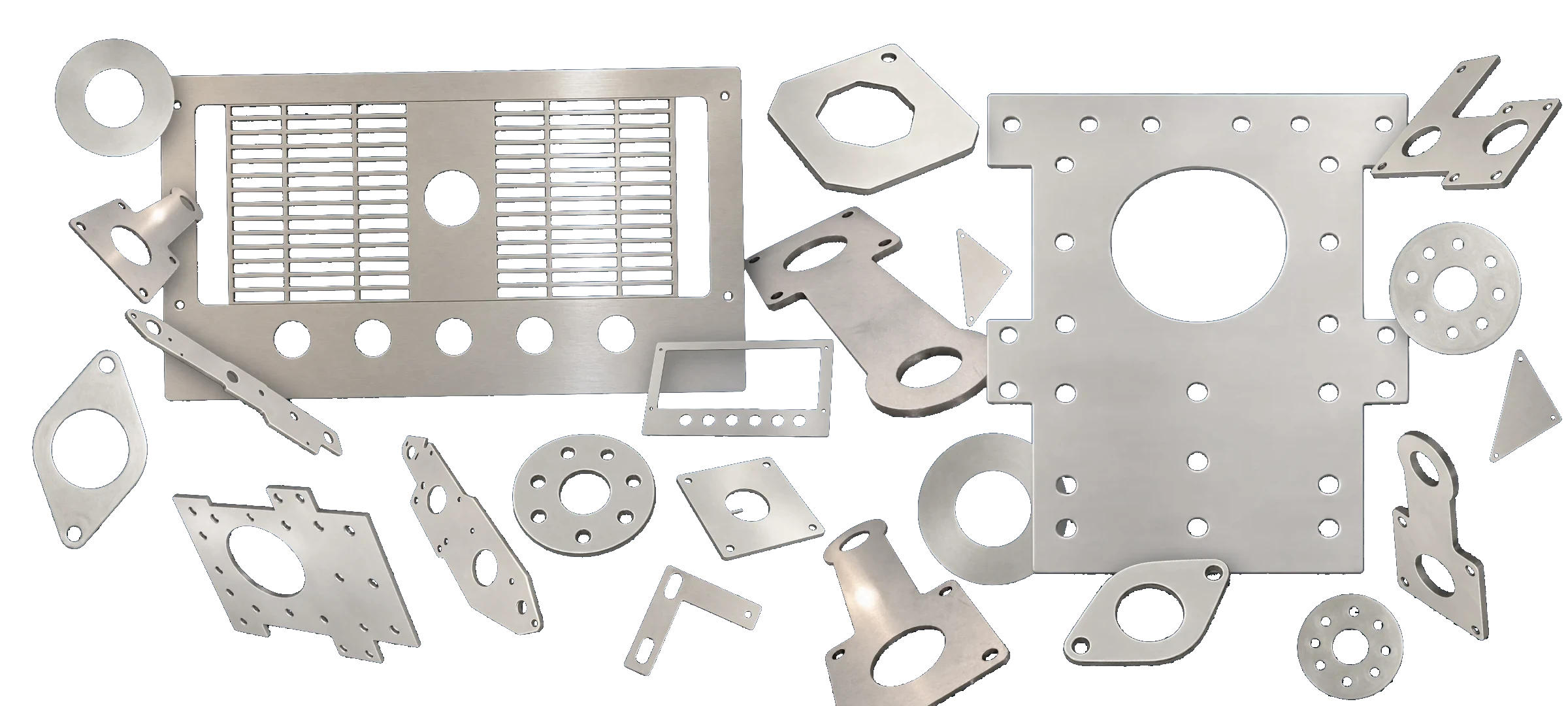
Laser-cut parts are thin-gauge metal components cut to the drawing with a laser — simple blanks or intricate contours — then CNC-finished or formed when specified. Here, “precision” means the accuracy and tight, repeatable tolerances the laser holds on thin sheet, not a separate product family. They are built for industrial equipment, machinery, and systems that need the part to fit the print.
We laser cut thin-gauge sheet and plate from roughly .015″ to .375″. Common stock gauges are listed below; other thicknesses in the band are cut to the drawing.
Full alloy and thickness detail lives on our materials page.
Material, thickness, and temper. Finished specifications, critical dimensions, and quantity. If a standard is invoked, put it on the print. We build to the drawing.
Laser-cut parts use the same metals and the same quality documentation as our nameplates. Nameplates are a separate product line.
Flat thin-gauge parts cut to contour — slots, holes, scales, irregular blanks, and panels. Stainless, aluminum, brass, cold-rolled steel. From your DXF, DWG, or PDF.
The same thin-gauge parts, bent or CNC-finished when the drawing calls for it — brackets, covers, countersinks, and hardware holes. Bending and forming, not structural fabrication.
Explore the options, materials, and process behind this product line.
We support prototyping and custom runs, so a prototype or sample part is often the first step for a new part — send your specs and we’ll advise. To request a quote, call 833.565.3346, email sales@specialtynp.com, or use the Request a Quote form with your drawing or specification, material, tolerances, and quantity. Because the work is fully custom, lead time and pricing are set from your RFQ, so we quote per project.
Send us your engineering requirements — a drawing, CAD file, or specification with material, dimensions, tolerances, thickness, and quantity — and we’ll turn it into a manufacturable part, recommending the process (laser cutting, CNC machining, forming) and material for your application. We support everything from a single prototype to a full production program.
We manufacture and document to ISO 9001 and AS9100 requirements — we are not ISO or AS9100 certified — and provide First Article Inspection (FAIR / AS9102), PPAP, and Certificates of Conformance per your purchase order and quality clause. US Manufactured, CAGE 8GNP1. Tell us the standards your part needs to meet and we’ll confirm exactly what we can provide.
We work in flat sheet and plate, roughly 0.015″ to 0.375″ thick, cut and machined to tight tolerances with high repeatability. Laser cutting delivers accurate profiles with clean edges, and CNC machining holds tight tolerances on complex geometries. Put the required tolerances on your drawing and we’ll confirm them against the part.
We work in stainless steel, aluminum, brass, and mild/cold-rolled steel (steel on request), selected to match your strength, corrosion-resistance, temperature, and weight requirements. Stainless suits corrosive and high-temperature service; aluminum offers light weight and machinability; brass provides good conductivity and formability. Because parts are custom-made, we recommend the material and grade against your environment and tolerances rather than defaulting to one option.
Yes. Our work is scalable — from one-off prototypes and low-volume custom runs through production. You can validate a design as a prototype, then move the same specification into production without re-sourcing or re-engineering. Whether you need a single proof-of-concept part or a repeatable production program, the process and tolerances stay consistent across quantities. No minimum order.
Beyond cutting, we machine and form flat sheet and plate to your engineering specification. CNC machining covers milling, turning, and drilling for complex geometries and tight tolerances. Forming and bending handle brackets, covers, and finished shapes — bending and forming, not structural fabrication. Multi-step work is available — a part can be laser-cut, then formed and machined into a finished flat or plate component.
Laser cutting uses a focused, CNC-controlled laser to cut metal with high accuracy and clean edges. Because it is a non-contact process, there is no tool wear and no mechanical stress on the part, which preserves material integrity and delivers consistent, repeatable results across a run. It excels at intricate geometries and detailed profiles that are difficult to achieve with mechanical cutting. We laser cut a range of thicknesses — from thin gauge up to 0.375″ — in stainless steel, aluminum, brass, and mild/cold-rolled steel.
Our laser-cut parts serve industries that demand tight tolerances and durable materials: aerospace and defense, machinery and equipment OEMs, energy and power (oil and gas, power generation), transportation, and marine. Across all of them the value is the same: flat and plate metal parts made to spec, cut or machined accurately, and built to perform in demanding conditions.
We provide a connected set of capabilities, all working in flat sheet and plate metal:
Many projects combine these — a laser-cut blank that is then formed and machined into a finished part.
Laser-cut parts are custom-engineered metal parts cut to tight tolerances with a laser, then machined or formed when the drawing calls for it. We produce them from flat sheet and plate — roughly 0.015″ to 0.375″ thick — where accuracy and repeatability matter. Here, “precision” describes the exacting tolerances and clean, accurate results these processes deliver, not a separate product line. Each part is built to your engineering specification rather than pulled from a catalog, so it integrates cleanly into your assembly.

We’d love to hear from you. Whether you have a specific project in mind or just want to ask about what’s possible — drop us a message. We usually respond within 1 business day.
Your information is safe with us. No spam, ever.
Need help choosing the right solution for your need? Our team of experts is here to assist!


Reach us on weekdays between 9am-5pm

