

We build core banding hardware under our CoreTight™ system: matched metal strap, matching seals, and the pneumatic tensioning tool that applies them, sourced and made to work together rather than assembled from three separate suppliers. Produced to Specialty Nameplate & Manufacturing, Inc. drawings in phosphor bronze, tin-coated steel, stainless (304/316), and brass, every coil carries documented material traceability, backed by sole U.S. distribution of the FEMAG tensioning tool. Match the material to your environment; each is built to a controlled standard, from raw material to finished crimp — in a line whose lineage traces back to Westinghouse. US Manufactured, CAGE 8GNP1.
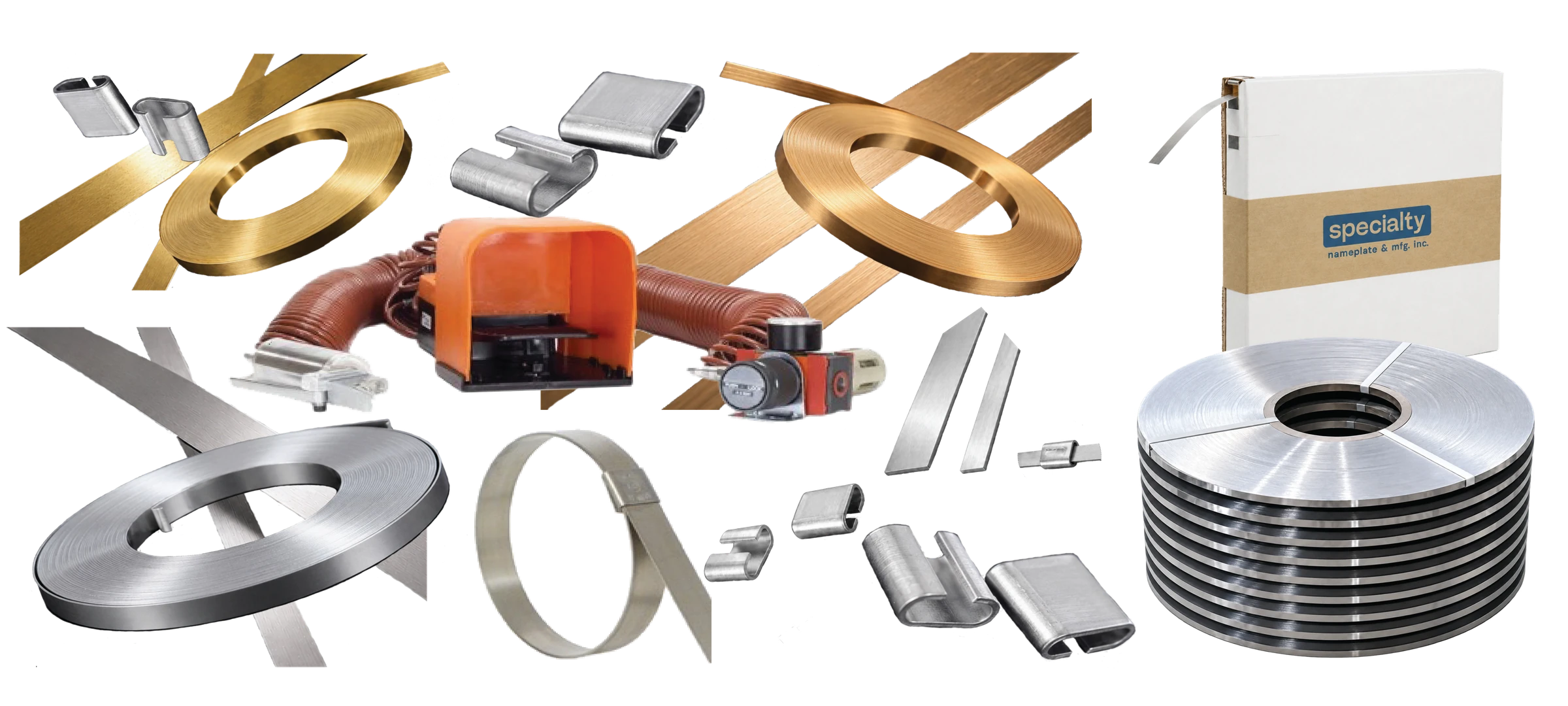
For aerospace, industrial, and power applications, precision-engineered banding strap and seals provide secure fastening, vibration resistance, and long-lasting durability. Our high-performance metal banding is available in Phosphor Bronze, Tin-Coated Steel, Stainless Steel (304 & 316), and Brass, meeting ASTM, MIL, and RoHS compliance standards.
✔ Engineered for High-Reliability Transformers
✔ Certified for Aerospace, Marine, and Industrial Use
✔ Corrosion-Resistant & High-Tensile Strength Materials
Choosing the right material depends on your application’s specific requirements. For electrical performance, tin-coated steel and brass are superior. For high-temperature or high-vibration environments, phosphor bronze and stainless steel (316) are excellent choices. Contact us for tailored recommendations and engineering support.
📄 Download the full CoreTight line card (PDF)
A cost-effective steel base finished with a protective tin layer for improved conductivity and corrosion resistance. It offers excellent solderability, making it ideal for electrical components and power systems. Best used where moderate corrosion protection and good electrical performance are required, but not suitable for high-temperature or high-vibration environments.
A strong, fatigue-resistant copper alloy designed for precision and durability under repeated stress. Its balanced conductivity, corrosion resistance, and mechanical stability make it a preferred choice for aerospace, high-vibration electronics, and demanding industrial applications. Less ideal where cost or solderability are key factors.
A versatile, corrosion-resistant stainless steel offering good strength, excellent temperature tolerance, and non-magnetic properties. Well-suited for industrial and high-heat transformer designs. Performs poorly in chloride-heavy environments and is not suitable when electrical conductivity is required.
A highly conductive and easy-to-form copper-zinc alloy used for low-voltage electrical components and customized parts. Affordable and workable, but limited by lower strength and moderate corrosion resistance. Not recommended for high-stress or vibration-heavy applications.
CoreTight formed steel seals lock banding-strap tension on transformer and magnetic-core assemblies — tin-plated after forming to MIL-T-10727C Type 1
The Femag SNP-PT-C125 pneumatic banding tool tensions CoreTight banding strap for a secure, repeatable lock.
Explore the options, materials, and process behind this product line.
In-stock CoreTight strap and seals ship within 24 hours. Custom work — non-standard sizes, materials, coatings, or higher volumes — is quoted per job, because lead time depends on quantity and specification; the fastest way to a firm date is to send your requirements and request a quote. Reach us at 833.565.3346, sales@specialtynp.com, or the Request a Quote form. Include material, size, quantity, and any governing specs or quality clauses; for a custom or first-article program, add core dimensions and environment so we can spec the right material and seal.
Yes. We provide samples on request so you can evaluate fit and quality before committing to a production quantity, and we support both high-volume and small-batch / OEM orders. Strap ships on self-dispensing cartons, and seals come 500 per box. For recurring OEM programs we can hold specifications and certifications on file to streamline reorders. Pricing is quoted per order — send your material, size, and quantity through Request a Quote for volume pricing.
Yes. Beyond the stocked line, CoreTight strap and seals can be produced in custom widths, lengths, thicknesses, materials, and coatings to fit your assembly and environment. Custom coatings are available for enhanced corrosion protection or conductivity, and custom seals can be made to match non-standard strap widths (full dimensioned drawings on request). Specialty Nameplate is a one-stop source — stock plus custom plus drawings plus certifications — so a custom program still ships with the CoC and mill certs your quality system needs. Send your core dimensions, load, environment, and any governing specs, and we’ll recommend a configuration.
Yes — light, routine maintenance keeps tension accurate and joints consistent. Keep the air supply clean and dry to prevent clogging of the pneumatic system; inspect the welding/crimp points regularly for consistent sealing; and lubricate moving components periodically. Because the tool relies on a regulated air-to-force relationship, a clean, properly pressured air supply is the single biggest factor in repeatable tension. If tension readings drift or seals look inconsistent, check air quality and pressure first. Detailed maintenance guidance ships with the tool.
Banding a C-core with the SNP-PT-C125 follows eleven steps: (1) introduce the seal onto the steel band; (2) loop the band around the transformer core; (3) feed the band into the pneumatic tool; (4) apply heat near the seal; (5) press the pedal to apply compression; (6) hold position to allow proper welding; (7) cover the seal with hot tin; (8) wait for the tin to cool; (9) press the inside pedal button to release; (10) cut the steel band near the seal; (11) secure the remaining band for extra reinforcement. The result is a soldered, tensioned joint that holds the core under controlled compression. A full illustrated instruction manual is available on request.
The SNP-PT-C125 is built for CoreTight strap and seals. The standard head accommodates band widths up to 0.400"; an optional interchangeable head extends capacity to 0.500" for greater flexibility. It runs 0.012"-thick band on coils up to 600 ft. After tensioning, the strap is secured with the matching CoreTight formed seal to complete the joint. Running the tool, strap, and seal as a matched set is what guarantees the tension and seal integrity the system is rated for — mixing in off-spec band or seals is not recommended.
The SNP-PT-C125 delivers a tension range of 0–125 kg, with a linear air-to-force relationship and a ±10% tolerance. It runs on a 8 kg/cm² (~114 psi) air supply. Because the pressure-to-tension relationship is linear and regulated, you set the air pressure and the tool applies a proportional, repeatable band tension — no conversion chart or manual calculation needed. This controlled tensioning is what prevents core misalignment and structural instability in the finished assembly.
The Femag SNP-PT-C125 is the pneumatic tensioning tool that completes the CoreTight system. It applies and tensions the strap around a C-core or cut-core magnetic assembly before the joint is locked with a matching formed seal, delivering controlled, repeatable tension. It uses air-to-force tensioning with a built-in pressure regulator that automatically adjusts the force applied to the band, so tension is consistent from joint to joint. The tool is manufactured by FEMAG (Ferri Magnetici s.r.l., Italy) to ISO 9001:2015, and Specialty Nameplate is the sole authorized U.S. distributor. Strap, seal, and tool are designed to function as one integrated banding system.
Yes. CoreTight banding strap and seals are US Manufactured by Specialty Nameplate & Manufacturing (Hubbard, OH; CAGE 8GNP1), and the material line is DFARS compliant along with RoHS 3, REACH, and Conflict-Minerals compliant. Specialty Nameplate is a Woman-Owned Small Business (WOSB). One note on origin for the tool specifically: the Femag SNP-PT-C125 pneumatic tool is made in Italy (Specialty Nameplate is the sole authorized U.S. distributor) and is classified ECCN EAR99, HTS 8467.29, BAA-exempt — the strap and seals are US Manufactured. This split matters for BAA/TAA and DFARS sourcing questions, so it’s called out plainly.
Yes. CoreTight orders can ship with a Certificate of Conformance (CoC) and mill certifications documenting the actual material. Because each strap and seal is made to a governing spec, the material certification supplied with each lot reports the real chemical and mechanical results for that lot — not just nominal values. We also provide full compliance documentation (ASTM, MIL, RoHS 3, REACH, Conflict Minerals, DFARS) on request, which supports regulated aerospace and defense supply chains. If your PO or quality clause requires specific certifications or first-article documentation, note it on the request and we'll include it.
CoreTight materials are manufactured and certified to the relevant industry standards: Tin-Coated Steel — MIL-T-10727C Type II (ASTM A109 base, tin per ASTM B339); Phosphor Bronze — ASTM B103 (C51000); Stainless 304/316 — ASTM A240 / AMS 5513; Brass — ASTM B36/B36M (C26000). Across the family, materials are RoHS 3, REACH, and Conflict-Minerals compliant, and DFARS compliant. Specialty Nameplate is a WOSB-certified, U.S.-based manufacturer (CAGE 8GNP1). Every order can ship with a Certificate of Conformance (CoC) and mill certifications, and full compliance documentation is available on request.
CoreTight seals are formed steel closures crimped over the strap to lock circumferential tension. Each seal is matched to a specific strap width and crimped with the pneumatic tool (or a manual crimp tool). Current catalog (500 per box):
Seals are tin-plated after forming (MIL-T-10727C Type 1) and supplied ready to crimp. Full dimensioned drawings are available on request, and custom seals can be produced.
CoreTight strap is stocked in two thicknesses — 0.006" and 0.012" — in widths of 0.187" and 0.375", on 300 ft coils, across the material line. Representative catalog parts:
The pneumatic tool handles band widths up to 0.400" standard (0.500" with the optional head) at 0.012" thickness. Custom sizes, materials, and coatings are available on request.
They're both tin, but specified differently — and the distinction matters on a controlled part. The strap's tin-coated version uses MIL-T-10727C Type II (both sides), applied to the steel band. The seal is a formed closure made from dead-soft CRS 1008 that is tin-plated after forming to MIL-T-10727C Type 1 (tin per ASTM B545-13), so the freshly formed edges are fully coated for solderability and corrosion protection. Both meet MIL-STD-202 Method 208 for solderability and carry a 36-month coating shelf life. If your documentation calls out a coating type, quote Type II for the strap and Type 1 for the seal.
CoreTight tin-coated strap use a cold-rolled 1010 low-carbon steel base with a 100% pure hot-dip tin coating per MIL-T-10727C Type II (both sides; tin per ASTM B339). The tin layer does two jobs: it protects the steel from oxidation and rust, and it makes the strap solderable — verified to MIL-STD-202 Method 208. That combination makes tin-coated steel the cost-effective choice for electronics and general C-core assembly where you want mechanical strength, good conductivity, and a solder-ready surface. Nominal coating thickness is 100–300 µin, tensile strength 70,000 psi min (483 MPa), with a 36-month shelf life from date of manufacture on the tin coating.
Phosphor Bronze — C51000, Grade A spring temper (ASTM B103) — is the go-to for high-vibration and aerospace transformers. Its spring temper delivers excellent fatigue resistance and spring-back retention, so the band holds tension through repeated cycling (rated to survive 10M+ cycles). Nominal composition is ~94.8% Cu / 5% Sn / 0.2% P, with high tensile strength (550–650 MPa) and good electrical conductivity (15–20% IACS). The trade-off is moderate corrosion resistance, so for high-vibration service that is also corrosive, we'll weigh phosphor bronze against stainless 316 with you. For navigation, high-frequency, and precision aerospace transformers, phosphor bronze is the default.
Stainless Steel Type 316 is the best choice for marine and chloride-exposed service. Its added molybdenum (nominally 2–3%, Cr 16–18% / Ni 10–14%) gives superior resistance to saltwater pitting compared with Type 304, and it meets ASTM A240 / AMS 5513. For general outdoor or high-temperature industrial use where chlorides aren't the main threat, Type 304 is a durable, more economical option. Both stainless grades are supplied cold-rolled and passivated with high tensile strength (≥515 MPa typical) and service temperature to ~870°C. For coastal power and marine transformer work, 316 is the standard recommendation.
Choose by the dominant stress in your assembly: corrosion, vibration, temperature, conductivity, or cost.
For high-temperature service, stainless holds integrity to ~870°C. If you're unsure, our team gives material recommendations and engineering support — send your environment, load, and core size and we'll spec it.
CoreTight strap is stocked in four materials, each matched to a different demand:
All four are ASTM/MIL/RoHS 3/REACH compliant, with a matching seal and tool to complete the system.
A C-core is a high-permeability magnetic core — shaped like the letter C — used to confine and guide magnetic fields in transformers, motors, generators, and other magnetic devices. Cut-core and stacked assemblies are built from layered magnetic material that must be held under steady compression so the stack doesn't shift, buzz, or delaminate under vibration and thermal cycling. Banding strap provides that clamping force around the core, and the seal locks the tension in place. Without proper banding, a core can lose alignment, generate audible noise, or fail mechanically over time. CoreTight's system delivers repeatable, controlled tension specifically for this job.
CoreTight banding is built for high-reliability industries where a fastening failure is not an option: Aerospace & Defense (secure banding for aircraft and mission transformers), Power & Electrical Systems (high-voltage transformer and magnetic-core fastening), Marine & Coastal (corrosion-resistant banding for salt and chloride exposure), and Industrial Equipment (high-tensile banding for heavy-duty transformers and reactors). The common thread is magnetic-core assemblies that must survive vibration, heat, and long service life. Because Specialty Nameplate is a U.S. manufacturer with CAGE 8GNP1 and DFARS-compliant, RoHS 3 / REACH / Conflict-Minerals-compliant materials, CoreTight fits regulated defense and OEM supply chains as well as commercial power work.
CoreTight™ banding strap and seals mechanically retain magnetic-component assemblies — C-core and cut-core transformers, inductors, reactors, and stacked magnetic or electronic assemblies. A pneumatic tool tensions the strap around the core stack, and a matching formed seal is crimped to lock it, holding controlled circumferential compression. That compression resists movement, vibration, and separation through handling, assembly, potting, and thermal cycling — protecting mechanical stability, electrical safety, and long-term structural integrity. Strap, seal, and tool are engineered to work as one integrated banding system, so the joint performs as a unit rather than as mixed-and-matched parts. CoreTight is manufactured in the USA by Specialty Nameplate & Manufacturing (CAGE 8GNP1) for aerospace, defense, and power applications.

We’d love to hear from you. Whether you have a specific project in mind or just want to ask about what’s possible — drop us a message. We usually respond within 1 business day.
Your information is safe with us. No spam, ever.
Need help choosing the right solution for your need? Our team of experts is here to assist!


Reach us on weekdays between 9am-5pm

