
Specialty Nameplate manufactures metal nameplates and industrial equipment tags — data plates, rating plates, and labels — in stainless steel 304/316/430, aluminum 1100/3003/5052/6061, anodized aluminum, photosensitive anodized aluminum (PSA), and brass. We chemically etch, engrave, laser-mark, screen-print, and digitally print identification plates built for outdoor, chemical, high-temperature, and high-vibration service. We mark to MIL-DTL-15024 plate types and apply MIL-STD-130 machine-readable marking when specified. Every job is quoted from your drawing. US Manufactured, CAGE 8GNP1.
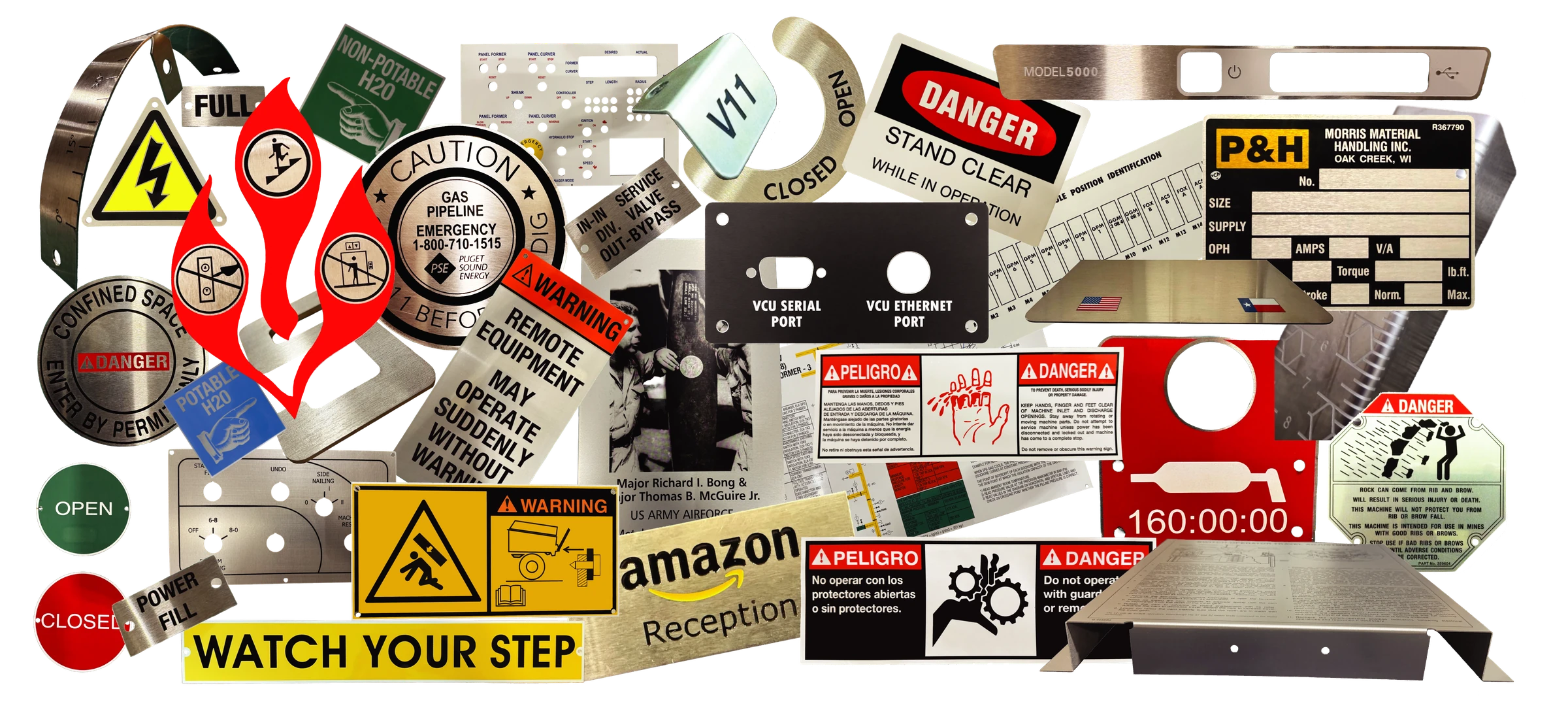
✔ Metal Nameplates & Tags– Stainless steel, aluminum, brass, and more.
✔ Chemical Etching – Permanent marking for lifetime readability.
✔ Panels & Overlays – Custom graphic overlays and faceplates for control panels and equipment interfaces.
✔ Decals & Labels – Polyester and polycarbonate industrial labels and printed decals, to your drawing — chemical-resistant, flexible, and durable.
Grouped by end use — find the plate that fits the job, from instruction and compliance to identification, controls, and branding.
Permanent instructional nameplates and labels for operating procedures, schematics, and on-equipment safety guidance.
OSHA/ANSI-compliant safety nameplates and labels: durable warnings, danger signs, and certification marks.
Custom ID nameplates and labels for serial, part, and asset marking, built for durability and long-term readability.
Durable metal plates and flexible labels that simplify inspection schedules, service records, and regulatory tracking.
Custom control-panel nameplates, labels, and flexible graphic overlays for keypads, interfaces, and equipment controls.
Rugged metal nameplates and labels engineered to withstand extreme temperatures, corrosion, and harsh industrial conditions.
Premium metal nameplates and printed labels that elevate brand identity with precision finishes and custom logo designs.
Explore the options, materials, and process behind this product line.
Nameplates are made to order, so the fastest way to a firm date is to send your specs and request a quote. Reach us at 833.565.3346, sales@specialtynp.com, or the Request a Quote form with your material, size, quantity, marking method, artwork or drawing, and any governing standard or quality clause. Because the work is fully custom, lead time and pricing are set from your RFQ — the variables in your specs drive both, so we quote per project.
Yes to both. We provide samples on request so you can evaluate material, marking, and quality before committing to a production quantity, and we support both small-batch and high-volume runs — from a handful of custom plates to large industrial programs. For recurring orders we can hold your specifications on file to streamline reorders. Pricing is quoted per order based on material, marking method, size, and quantity.
Yes. We provide fully customized nameplates tailored to your size, shape, finish, material, and marking method, and we work with you from design consultation through production. Send artwork, a drawing, or just your requirements and specifications, and our team will turn it into a manufacturable plate — including material and marking recommendations for your environment and compliance needs. Whether it's a single custom data plate or a branded product line, the design is built to your spec.
Common mounting options include adhesive backing for generally flat surfaces, mechanical fastening (screw or rivet holes) for high-vibration environments where adhesives aren't enough, and magnetic backing for removable, reusable tags. The right choice depends on the surface, the environment, and whether the plate needs to be permanent or removable — we'll recommend a mounting method with your plate.
Yes. Barcodes, QR codes, and serial numbers can be etched, engraved, or laser-marked for permanent, high-contrast, machine-readable results — ideal for asset tracking, inventory management, maintenance records, and regulatory traceability. For the most durable scannable marking in harsh environments, Photo-Sensitive Aluminum embeds high-resolution codes into the metal so they stay scannable for decades. We handle sequential serialization and variable data across a production run, and can mark to MIL-STD-130 / MIL-DTL-15024 requirements where item-level traceability is mandated.
Yes — nameplates are made to order in virtually any shape and size. Standard shapes include rectangles for data plates, ovals for decorative plates, and squares for general use, and we do custom contour cutting for logo plates, branding, and specialized fits. Sizes range from small identification tags for tools and asset tracking up to large-scale data plates for industrial equipment. Send us your dimensions or a drawing and we'll match the plate to your equipment exactly.
Yes — that's the core of what metal identification is for. For high-temperature service (power generation, engines, turbines, heat exchangers), stainless steel holds structural integrity and legibility under heat. For corrosive or marine exposure, stainless 316 and anodized aluminum resist saltwater, chemicals, and moisture. For abrasive or high-vibration settings like mining and heavy machinery, etched or engraved plates keep their markings because the data is cut into the metal, not printed on it. And for outdoor UV exposure, anodized aluminum and PSA resist fading. We select the material and marking method specifically against your environment, so the plate stays readable for the life of the asset.
Depending on the material and marking method, metal nameplates last for decades. Etched stainless steel offers the longest lifespan, staying legible even under continuous chemical, UV, and high-temperature exposure. Photo-Sensitive Aluminum is rated for 20+ years outdoors, with the image embedded in the metal so it can't wear off. Anodized aluminum performs well outdoors thanks to its protective oxide layer. Printed finishes (screen, digital) have shorter field lives unless protected with a coating. In short: for maximum longevity in harsh environments, etched stainless or PSA will outlast the equipment they're mounted on.
We build identification plates and tags to the standard your drawing names. The most common for metal nameplates are:
Mark quality is verified to ISO/IEC 15415 and AS9132 when your drawing requires it. We're a U.S. manufacturer (CAGE 8GNP1) and supply compliance documentation with your order — tell us the standard your drawing calls out and we'll make the plate to it. Full chart on our Standards page.
Yes, several ways depending on the look and durability you need. Anodized aluminum can be produced in a range of colors with a durable, UV-resistant finish. Etched and engraved plates can be color-filled to make markings pop and improve readability — a common choice for safety and instructional plates. Screen printing and digital printing deliver full-color and multi-color designs, ideal for logos and branding, with digital printing handling photographic detail and gradients. For color that must survive harsh outdoor or chemical exposure, anodizing or color-filled etching outlasts printed color; for vivid multi-color branding indoors, screen or digital printing is the better fit.
Etching offers greater fine detail and precision than engraving, and far more durability than any printing method. In the etched process, a protective mask exposes only the areas to be marked, then a controlled acid bath removes material to create deep, permanent marks — followed by optional color fill, polishing, and inspection. The result withstands chemicals, UV, and extreme temperatures for decades, which is why it's the standard for machine-identification plates, serial-number tags, and safety labels. Engraving is excellent for precise variable data (serial numbers and traceability marking). Printed methods (screen, digital) win on color and speed but can fade or peel over time unless coated. If the plate must stay legible in the field for the life of the equipment, etching or engraving is the answer.
For the harshest service, etching and engraving are the most durable — they physically alter the metal, so the mark can't wear, fade, or peel, and both hold up to abrasion, chemicals, UV, and extreme temperatures. Photo-Sensitive Aluminum is the other top choice when you also need high-resolution detail, since the image is embedded in the metal (20+ year outdoor legibility). Laser marking is durable and fast but shallower than etching or engraving. Screen and digital printing are best kept to indoor or low-wear applications unless a protective coating is added, because printed surfaces can fade or abrade over time. For outdoor equipment, compliance, and safety plates, we default to etched stainless steel or PSA.
We match the method to your durability, detail, and color needs:
Many plates combine methods — for example, etched compliance data with a screen-printed logo.
Photo-Sensitive Aluminum (PSA) is a specialized aluminum coated with a photosensitive layer that lets us embed high-resolution images, fine text, barcodes, and QR codes directly into the metal — the mark is flush with the surface, not printed on top. That makes it exceptionally durable: resistant to abrasion, chemicals, UV, and extreme temperatures, with legibility rated 20+ years even outdoors. Use PSA when you need fine detail and long life — industrial nameplates, asset and inventory tags, control panels and instructional plates, harsh-environment signage, and aerospace/defense applications. The trade-off is color: PSA is typically black graphics on a silver or gold background rather than full color, and it costs more than screen-printed or laser-etched plates. For precision, permanence, and scannable codes that must survive the field, it's the strongest choice.
Choose by the dominant demand on the plate:
Also weigh the marking method: stainless supports deep etching and engraving; aluminum excels at laser marking and digital printing. Send us your environment, durability target, and marking needs and we'll recommend the substrate and grade.
We work in the full range of nameplate substrates, each suited to a different demand:
The right choice depends on environment, durability, marking method, and budget — we'll spec it with you.
Our nameplates are trusted across a broad range of industries where durability, accuracy, and compliance are non-negotiable: Industrial Machinery (data and compliance plates), Oil & Gas (corrosion-resistant pipeline and rig tags), Energy & Power Transmission (high-temperature plates for transformers, turbines, generators), Mining (heavy-duty safety and equipment plates), Marine (saltwater-resistant equipment nameplates), HVAC, Rail & Transportation, Boilers & Pressure Vessels, Heat Exchangers, and Valves, and Aerospace & Defense (MIL-DTL-15024 and MIL-STD-130 component and ground-support tags). Each application drives a different material and marking choice — corrosion resistance for marine, high-temperature tolerance for energy, and high-resolution permanence for the most demanding traceability.
We build the full range of industrial identification, organized by function:
Every type is custom-made to your material, size, and marking method.
Metal nameplates are durable identification products that permanently mark and label equipment, tools, and products — carrying serial numbers, safety and compliance information, operating data, and branding. Because they’re made from metal and marked by processes like etching or engraving, they stay legible for decades in conditions that destroy paper or plastic labels: extreme temperatures, chemicals, moisture, UV, and abrasion. That durability is why they’re standard across industrial, aerospace, medical, marine, and energy applications, where an unreadable tag can mean a compliance failure or a safety risk. Specialty Nameplate manufactures custom metal nameplates and labels in the USA, engineered to your material, marking method, and compliance requirements.

We’d love to hear from you. Whether you have a specific project in mind or just want to ask about what’s possible — drop us a message. We usually respond within 1 business day.
Your information is safe with us. No spam, ever.
Need help choosing the right solution for your need? Our team of experts is here to assist!


Reach us on weekdays between 9am-5pm

